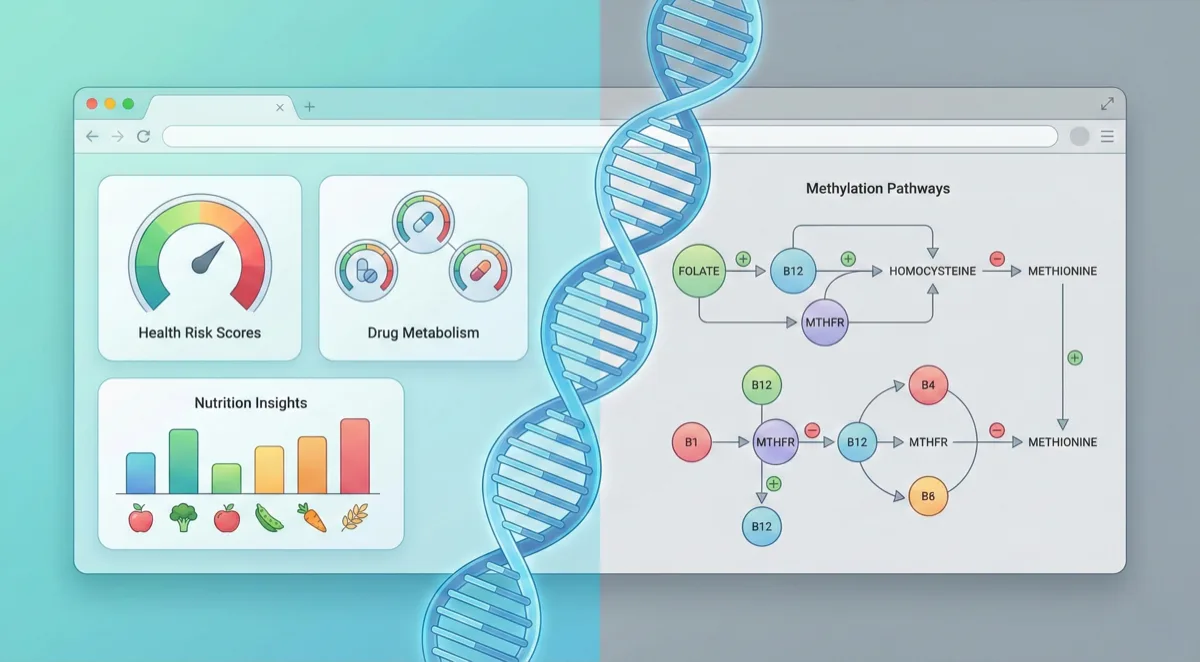
DNA Explore vs Genetic Genie
Genetic Genie is a free methylation and detox tool that's been a staple in the functional medicine community for years. But in 2026, is uploading your raw DNA to a third-party server still worth a free report on a handful of genes?
Key Takeaways
- Genetic Genie is free but covers only ~20 methylation/detox SNPs; DNA Explore analyzes 1,000+ variants across all health categories for $9.99
- Genetic Genie requires uploading your DNA file to their servers; their own terms explicitly warn of breach risk
- Genetic Genie has a documented CBS gene bug on hg38 reference genomes that may show false-normal results
- Genetic Genie reports variants in isolation; DNA Explore models gene-gene interactions that are clinically meaningful in methylation pathways
“I signed up for 23andMe in 2017 because I was fascinated by what my DNA could tell me. Six years later, my data was compromised in their breach — I'm a confirmed class member in the litigation. I didn't want to hand my genetic data to another company, so I built a tool where everything stays on your device. Then I thought: why not give people what I was actually searching for when I got my DNA tested in the first place — actionable health insights, drug metabolism analysis, risk scores — things you can actually do something with.”
Genetic Genie has been around for years as a free tool that analyzes methylation (MTHFR and related genes) and detoxification pathways from your 23andMe data. It’s popular in the functional medicine and biohacking communities because it’s free, straightforward, and covers the key methylation variants people are most curious about.
But the landscape has changed. Data breaches are rampant, consumer expectations for health technology have evolved far beyond static HTML tables, and Genetic Genie’s own terms of service now explicitly warn users that uploading data carries breach risk. If you’re trying to understand your genetic health, is a free report on a narrow set of genes still the right tradeoff?
Here’s how Genetic Genie compares to DNA Explore across scope, privacy, accuracy, and overall value.
Quick Comparison
| DNA Explore | Genetic Genie | |
|---|---|---|
| Price | $9.99 one-time | Free (donation supported) |
| Scope | 1,000+ SNPs (all health categories) | ∼20 SNPs methylation + detox + GenVue Discovery |
| Polygenic risk scores | Yes | No |
| Pharmacogenomics | Yes | Detox/CYP450 only |
| Nutrigenomics | Yes | Methylation nutrients only |
| Gene interactions | Yes | No (variants reported independently) |
| AI-powered chat | Yes | No |
| Data on their servers | Never | Uploaded; deleted within 24 hrs |
| Staff can view uploaded data | Never | Yes (for service improvement) |
| Own terms warn of breach risk | N/A | Yes (explicitly) |
| Known CBS gene bug (hg38) | N/A | Yes (documented) |
| Free health risk score | 1 condition w/ percentile | No |
| Free drug metabolism | 1 gene result | No |
| Free nutrition insight | 1 personalized insight | No |
| Active development | Yes | GenVue added; methylation panel unchanged |
| Modern interface | Yes | Basic HTML table |
What you get without paying a cent
DNA Explore — Free
- Personalized genome narrative & summary
- 1 polygenic health risk score with percentile
- 1 drug metabolism gene result
- 1 nutrition & gene insight
- Genetic rarity score & chromosome map
- No account, no upload — runs in your browser
$9.99 one-time unlocks everything: all 5 risk scores, all drug genes, AI chat, gene interactions & more.
Genetic Genie — Free
Methylation and detox profile reports are free. No health risk scores, no drug metabolism, no nutrition insights.
Free vs. Comprehensive
Even with GenVue, the platform remains narrowly focused on methylation, detox, and a limited discovery set. It doesn't compute polygenic risk scores, doesn't offer full pharmacogenomics, and doesn't analyze gene interaction effects. DNA Explore covers over 1,000 curated variants across health risks, drug metabolism, nutrition, and gene interactions — an order of magnitude more coverage for the price of a couple of coffees.
Privacy: The Real Cost of Free
But there are nuances worth knowing. Their privacy policy acknowledges that staff may occasionally view uploaded data “for the purposes of improving this service.” Generated PDF and HTML archive files are retained for up to 24 hours even after processing. And their own terms of service contain an unusually direct disclaimer: users uploading their data must acknowledge they “are taking a risk in the event that the service becomes compromised.” That's a frank disclosure you rarely see — Genetic Genie openly confirming that a breach would expose your raw genetic data.
DNA Explore has no equivalent disclosure because there is no upload to compromise. Your raw DNA file is processed entirely within your browser — no transit, no 24-hour window, and no possible staff viewing. For privacy-conscious users in the MTHFR community who are deeply protective of their health data, this architectural difference matters. Learn more about protecting your DNA data after breaches.
MTHFR and Methylation: Variants in Isolation vs. Gene Interactions
However, genes don't operate in a vacuum. A 2025 study found that the combination of MTHFR C677T with MTRR A66G produces significantly disrupted methyl flux that neither variant predicts alone, and that the combination of MTHFR C677T/A1298C with MTR A2756G compounds the effect further. Genetic Genie reports each variant independently — each gets its own row in the table. It can't surface these compounding interactions. DNA Explore's gene interaction analysis specifically looks for these effects, which in the methylation pathway are clinically meaningful.
There's also a known accuracy issue. Genetic Genie's own FAQ documents a CBS gene bug: on hg38/GRCh38 reference genomes (which most modern DNA files use), CBS variants may display as normal (green) even when the user carries a heterozygous or homozygous risk variant. The error isn't flagged to users — the result simply looks clean. CBS variants affect sulfur metabolism and homocysteine levels, so a false negative here has real health implications.
Interface and Experience: 2012 vs. 2026
Who Genetic Genie Is For
The Verdict
Genetic Genie is a commendable legacy tool that helped pioneer consumer access to methylation data. If you only want to check your MTHFR status and don’t mind the server upload, it’s still free and functional. But if you want a complete picture of your genetic health — computed risk scores, drug metabolism, nutrition, gene interactions, and an AI tutor to explain it all — DNA Explore is the clear upgrade. For $9.99 one-time, you get comprehensive, interactive insights with zero-trust privacy.
Frequently Asked Questions
Is Genetic Genie still working in 2026?
Is Genetic Genie free?
Does Genetic Genie check MTHFR mutations?
Is Genetic Genie safe for my DNA data?
What is the best alternative to Genetic Genie?
Sources & References
Drop your 23andMe or AncestryDNA file. Results in seconds. $9.99 to unlock everything.
Already purchased? Restore your access