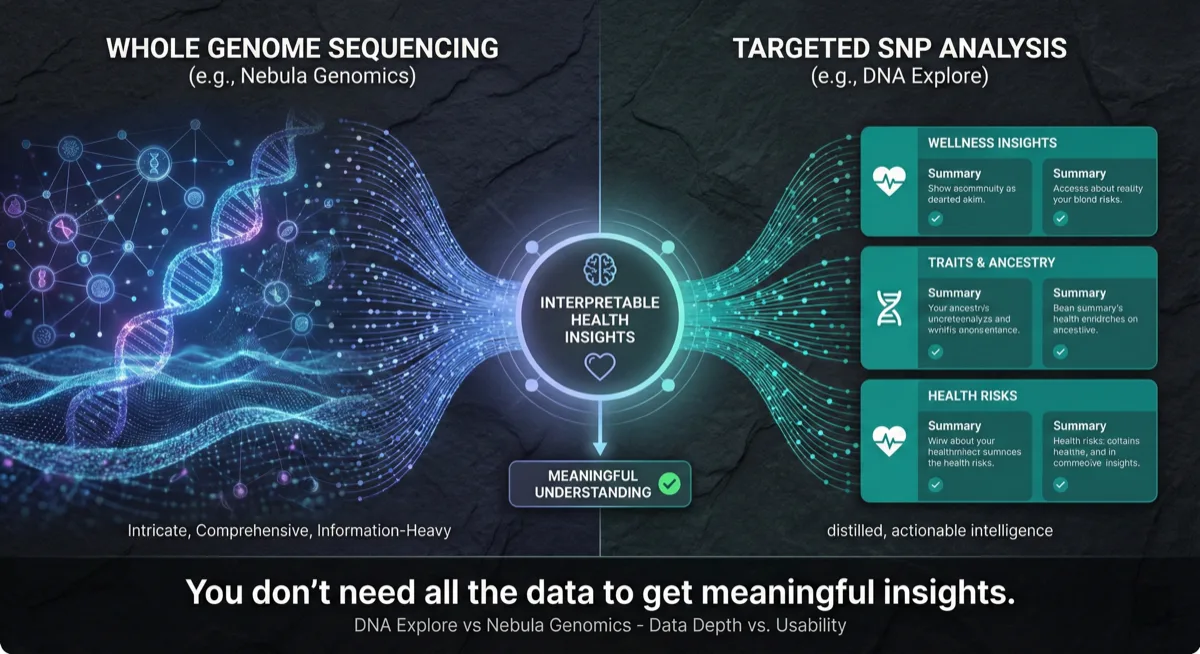
DNA Explore vs Nebula Genomics — visual comparison

DNA Explore vs Nebula Genomics

Nebula offers whole genome sequencing with a privacy-first approach. But if you already have 23andMe data, do you need to sequence again?

Last updated: 6 min read

Key Takeaways

  • Nebula offers whole genome sequencing ($99–$999); DNA Explore analyzes your existing 23andMe/AncestryDNA data for $9.99 one-time
  • Nebula results take 6–12 weeks; DNA Explore delivers results in seconds
  • Nebula stores your data on their servers (blockchain-based access control); DNA Explore processes everything locally in your browser
  • If you already have 23andMe or AncestryDNA data, you likely don't need new sequencing — just better analysis
“I signed up for 23andMe in 2017 because I was fascinated by what my DNA could tell me. Six years later, my data was compromised in their breach — I'm a confirmed class member in the litigation. I didn't want to hand my genetic data to another company, so I built a tool where everything stays on your device. Then I thought: why not give people what I was actually searching for when I got my DNA tested in the first place — actionable health insights, drug metabolism analysis, risk scores — things you can actually do something with.”

Peter Hollens

Founder, DNA Explore · Wikipedia

Nebula Genomics stands out in the consumer genomics space for two reasons: they offer affordable whole genome sequencing (30x coverage), and they were founded with a blockchain-based privacy model. Co-founded by Harvard geneticist George Church, Nebula has strong scientific credibility.

But here's the thing: if you already have 23andMe or AncestryDNA data, you don't need to sequence again. You need a tool to analyze the data you already have. That's exactly what DNA Explore does — and it does it instantly, privately, and for a fraction of the cost.

Let's compare what each platform offers and who each one is best for.

Quick Comparison

DNA ExploreNebula
Price$9.99 one-time$99 — $999
What you getAnalysis of existing dataNew sequencing + analysis
Time to resultsSeconds6-12 weeks
Account requiredNoYes
Data on their serversNeverYes
Works with 23andMe filesYesLimited
Polygenic risk scoresYesYes
PharmacogenomicsYesYes
AI-powered chatYesNo
Free health risk score1 condition w/ percentileNo
Free drug metabolism1 gene resultNo
Free nutrition insight1 personalized insightNo

What you get without paying a cent

DNA Explore — Free

  • Personalized genome narrative & summary
  • 1 polygenic health risk score with percentile
  • 1 drug metabolism gene result
  • 1 nutrition & gene insight
  • Genetic rarity score & chromosome map
  • No account, no upload — runs in your browser

$9.99 one-time unlocks everything: all 5 risk scores, all drug genes, AI chat, gene interactions & more.

Nebula — Free

No free tier — requires $99–$999 sequencing purchase before seeing any results.

Different Products for Different Needs

Nebula and DNA Explore solve different problems. Nebula is a sequencing company — you send them a saliva sample and they sequence your entire genome at 30x coverage. DNA Explore is an analysis tool — you already have your data and want to understand it. If you don't have any DNA data yet and want comprehensive whole genome sequencing, Nebula is one of the best options. But if you already have 23andMe or AncestryDNA results sitting in a file on your computer, DNA Explore analyzes them instantly without any additional cost, sample collection, or waiting.

Privacy Approaches

Nebula was built with privacy in mind and uses blockchain technology for data access control. That's better than most competitors and reflects the scientific team's understanding of genetic data sensitivity. However, your sequencing data still lives on their servers — it has to, because they need to process your physical sample. DNA Explore's privacy model is simpler and arguably stronger: your data never touches any server. There's no blockchain needed because there's no data to control access to — it stays in your browser. Both companies take privacy seriously, but the architectural approaches are fundamentally different.

The Coverage Question

Nebula sequences your full genome (~3 billion base pairs at 30x coverage), while 23andMe/AncestryDNA data covers ~600,000-700,000 SNPs. In theory, whole genome data is more complete — it captures structural variants, rare mutations, and non-coding regions that SNP chips miss. In practice, the well-studied variants that drive consumer health insights are well-covered by SNP chips. DNA Explore focuses on the ~1,000 most researched and clinically relevant SNPs, which is where the actionable insights live — including polygenic risk scores that combine multiple variants into meaningful health predictions. Unless you're doing clinical-grade genetic testing for rare conditions, SNP-based analysis covers the variants that matter most for health optimization.

Cost and Time Comparison

Nebula's whole genome sequencing ranges from $99 (low-pass, ~0.4x coverage) to $999 (deep, 30x coverage), plus you need to wait 6-12 weeks for results. DNA Explore processes your existing data in seconds for a fraction of the cost. If you've already been tested by 23andMe or AncestryDNA, spending $99-$999 more and waiting weeks for new sequencing may not be necessary — especially when the health insights from your existing data haven't been fully explored yet. For a full comparison of affordable options, see our cheapest DNA test guide for 2026.

Who Nebula Is For

If you don't have any DNA data and want the most comprehensive sequencing available to consumers, Nebula is an excellent choice. Their scientific pedigree (co-founded by George Church) is unmatched, and 30x whole genome sequencing provides data that no SNP chip can match. But if you already have 23andMe or AncestryDNA data gathering dust on your hard drive, DNA Explore turns it into actionable health insights in seconds, for a tenth of the cost, with zero waiting.

The Verdict

Nebula Genomics and DNA Explore serve different parts of the journey. Nebula is for getting sequenced. DNA Explore is for understanding data you already have. If you've got a 23andMe or AncestryDNA file, DNA Explore gives you instant insights for $9.99 — no need to spend $99-$999 and wait 6-12 weeks for new sequencing.

Frequently Asked Questions

Do I need whole genome sequencing if I have 23andMe data?
For most health optimization purposes, no. 23andMe and AncestryDNA cover the well-studied SNPs that drive consumer health insights. Whole genome sequencing adds value for rare disease screening and structural variants, but the actionable health insights from SNP data are substantial. DNA Explore analyzes your existing data for polygenic risk scores, drug metabolism, nutrition, and more.
Is Nebula Genomics trustworthy?
Yes — Nebula was co-founded by Harvard geneticist George Church and uses blockchain-based privacy controls. However, your sequencing data is still stored on their servers. DNA Explore's approach is architecturally different: your data never leaves your browser.
How long does Nebula Genomics take?
Nebula takes 6-12 weeks from saliva sample to results for whole genome sequencing. DNA Explore analyzes your existing 23andMe or AncestryDNA file in seconds — just drop the file in your browser and see results immediately.
Can DNA Explore analyze Nebula Genomics data?
DNA Explore currently supports 23andMe and AncestryDNA raw data formats. Nebula Genomics uses a different format (VCF/whole genome). If you have both Nebula and 23andMe data, you can use DNA Explore with your 23andMe file.
What's cheaper — Nebula or DNA Explore?
Nebula costs $99-$999 for sequencing. DNA Explore costs $9.99 to analyze data you already have. If you've already been tested by 23andMe or AncestryDNA, DNA Explore is dramatically cheaper and gives you results in seconds instead of weeks.

Sources & References

  1. NIH: The Cost of Sequencing a Human Genome
  2. DNA Explore methodology
Try DNA Explore free

Drop your 23andMe or AncestryDNA file. Results in seconds. $9.99 to unlock everything.

Already purchased? Restore your access