DNA Explore vs Promethease
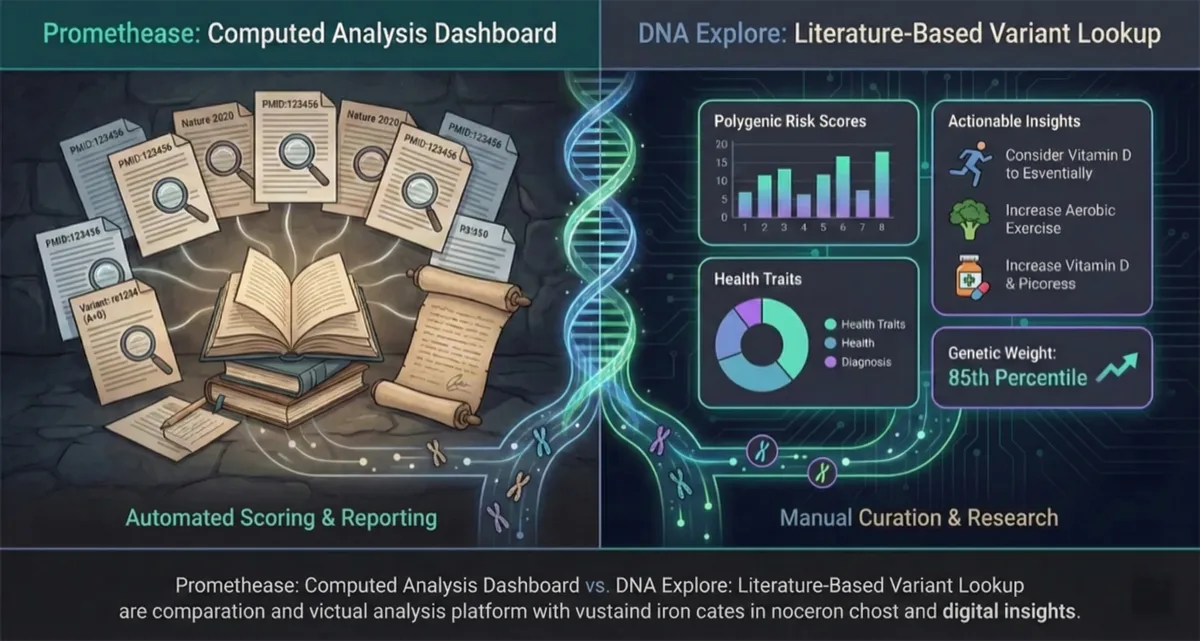
Promethease is one of the original tools for interpreting raw consumer DNA files using SNPedia. DNA Explore is a browser-first approach that emphasizes local processing, computed risk models, and optional AI explanations. Here’s how they compare.
Key Takeaways
- Promethease costs $15 one-time; DNA Explore costs $9.99 one-time with significantly more features
- Promethease requires uploading your file to MyHeritage servers; DNA Explore processes locally in your browser
- DNA Explore adds polygenic risk scores, nutrigenomics, gene interactions, and AI chat — none available in Promethease
- In 2019, Promethease users' DNA files were auto-migrated to MyHeritage accounts without opt-in consent
“I signed up for 23andMe in 2017 because I was fascinated by what my DNA could tell me. Six years later, my data was compromised in their breach — I'm a confirmed class member in the litigation. I didn't want to hand my genetic data to another company, so I built a tool where everything stays on your device. Then I thought: why not give people what I was actually searching for when I got my DNA tested in the first place — actionable health insights, drug metabolism analysis, risk scores — things you can actually do something with.”
Promethease has been a go-to tool for DNA enthusiasts since 2011, offering SNPedia-powered reports for a one-time fee. It's well-known in the biohacking and genetic genealogy communities. But the landscape has changed — Promethease was acquired by MyHeritage in 2019, which raised privacy concerns for many users who specifically chose Promethease because it wasn't tied to a major consumer genetics company.
DNA Explore takes a fundamentally different approach. Instead of uploading your raw file to a server, everything is processed locally in your browser. Your genome file never leaves your device. And beyond the basic SNP lookup that Promethease provides, DNA Explore adds polygenic risk scores, pharmacogenomics, nutrigenomics, gene interactions, and AI-powered explanations.
Let's break down exactly how they compare across price, privacy, speed, features, and overall experience.
Quick Comparison
| DNA Explore | Promethease | |
|---|---|---|
| Price | $9.99 one-time | $15 one-time |
| Time to results | Seconds | Under 10 min |
| Account required | No | Yes |
| Data uploaded to servers | Never | Yes |
| Data auto-migrated to 3rd party | Never | Yes (2019) |
| Polygenic risk scores | Yes | No |
| Pharmacogenomics | Yes | Yes |
| Nutrigenomics | Yes | No |
| Gene interactions | Yes | No |
| AI-powered chat | Yes | No |
| Doctor visit prep sheet | Yes | No |
| Free health risk score | 1 condition w/ percentile | No |
| Free drug metabolism | 1 gene result | No |
| Free nutrition insight | 1 personalized insight | No |
What you get without paying a cent
DNA Explore — Free
- Personalized genome narrative & summary
- 1 polygenic health risk score with percentile
- 1 drug metabolism gene result
- 1 nutrition & gene insight
- Genetic rarity score & chromosome map
- No account, no upload — runs in your browser
$9.99 one-time unlocks everything: all 5 risk scores, all drug genes, AI chat, gene interactions & more.
Promethease — Free
No free tier — $15 one-time fee required before seeing any results.
Privacy: Three Tiers of Data Handling
1. Local-only processing (DNA Explore default). Your raw genome file is parsed and analyzed entirely in your browser using JavaScript. There is no upload endpoint, no server-side database, nothing to breach or subpoena. Your file never leaves your device.
2. Upload, generate, delete (Promethease). Promethease requires you to upload your raw DNA file to their servers for report generation. To their credit, Promethease's privacy policy (updated April 2025) states that uploaded DNA files and generated reports are deleted immediately after the report is emailed to you — they no longer store raw DNA files long-term. However, your file does leave your device during the process, and the service is now operated under MyHeritage's infrastructure.
3. AI-assisted interpretation (DNA Explore opt-in). When you opt into DNA Explore's AI features, variant summaries — not your raw genome file — are sent to Anthropic's Claude for plain-English explanations. Your raw file still never leaves your browser; only the specific variant context needed for the question is transmitted. This is fully optional and disabled by default.
The broader context matters too. The 2018 MyHeritage breach exposed the email addresses and hashed passwords of 92 million users. MyHeritage stated that genetic data was stored on separate, segregated systems and was not accessed in the incident. Still, after the 23andMe bankruptcy put 15 million people's genetic data at risk, architectural privacy — where there's simply no data to breach — matters more than ever.
Features: SNP Lookup vs. Full Analysis
DNA Explore goes further: it calculates polygenic risk scores across multiple conditions (combining many variants into a single risk estimate), analyzes drug metabolism genes (pharmacogenomics) so you know how you process common medications, checks gene-gene interactions that affect your health beyond individual variants, provides nutrigenomics recommendations based on your genetic profile, and includes an AI chat that can explain any finding in plain English.
Polygenic risk scores aggregate the small, cumulative effects of hundreds or thousands of variants identified in genome-wide association studies (GWAS), each weighted by its statistically established effect size. This is fundamentally different from what Promethease does — Promethease reports what individual variants mean in isolation; DNA Explore computes how they add up. It's the difference between a dictionary and a tutor.
Speed and Experience
Who Promethease Is Still Good For
Promethease After the MyHeritage Acquisition
The most controversial consequence was the automatic data migration. As of November 1, 2019, all non-European Promethease users had their raw DNA files automatically copied to newly created MyHeritage accounts — without needing to opt in. European users (protected by GDPR) had to actively consent, but everyone else had to opt out by deleting their data before the deadline. Some users on Reddit reported that their data was transferred even after they had deleted it from Promethease before the cutoff date. For users who had specifically chosen Promethease because it was independent of major consumer platforms, this was a significant breach of trust.
The 2018 MyHeritage breach — which exposed the email addresses and hashed passwords of 92 million users (MyHeritage stated genetic data was on segregated systems and was not accessed) — added to the unease. To Promethease's credit, their current privacy policy (April 2025) states that uploaded DNA files and reports are deleted immediately after report delivery, which is a meaningful improvement. But the 2019 auto-migration episode remains a cautionary example of what can happen when your genetic data sits on someone else's server: even if you trust the company today, acquisitions and policy changes can move your data in ways you never agreed to.
If data sovereignty is important to you, the architecture of your analysis tool matters more than the brand behind it.
The Verdict
If your main goal is SNPedia breadth and you're fine with uploading your raw file for server-side report generation, Promethease remains a known quantity at $15. If you want local-first analysis with computed risk models, pharmacogenomics, nutrigenomics, gene interactions, AI explanations, and the assurance that your raw file never leaves your browser, DNA Explore is the more comprehensive and more private option.
Frequently Asked Questions
Is Promethease safe to use in 2026?
Is DNA Explore better than Promethease?
How much does Promethease cost vs DNA Explore?
Does Promethease work with 23andMe data?
What happened to Promethease after MyHeritage bought it?
Sources & References
Drop your 23andMe or AncestryDNA file. Results in seconds. $9.99 to unlock everything.
Already purchased? Restore your access