DNA Explore vs LiveWello
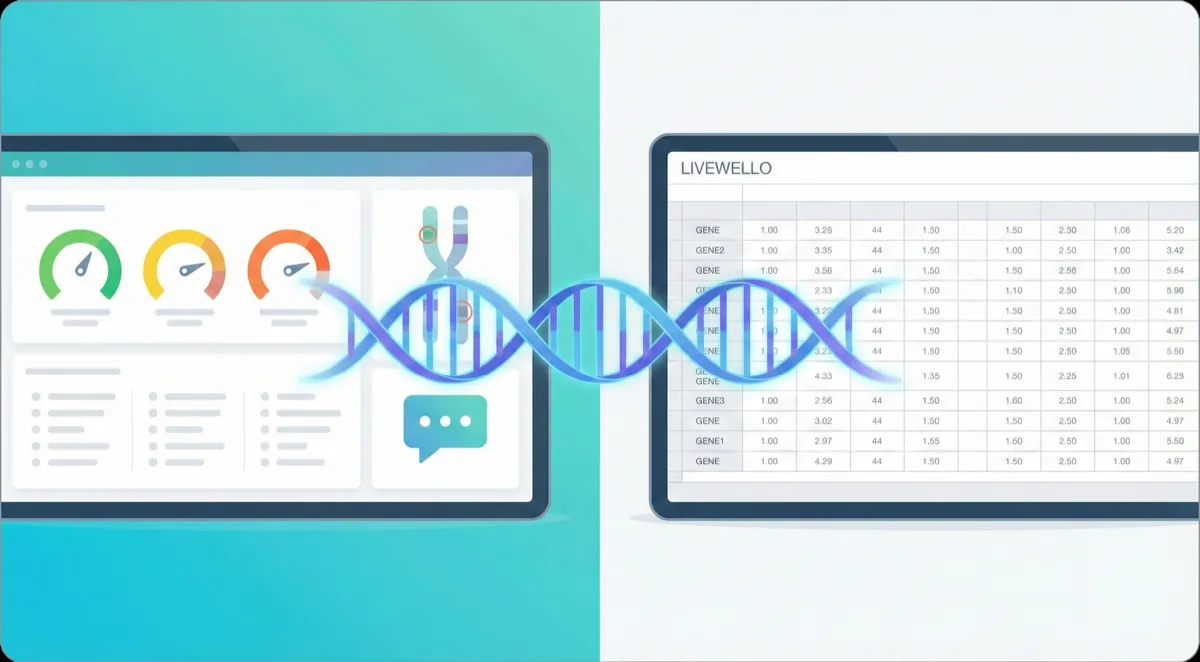
LiveWello is a variant research workstation built for functional medicine practitioners. DNA Explore computes your actual risks and explains them in plain English. Here's how the spreadsheet approach compares to synthesized health intelligence.
Key Takeaways
- LiveWello shows raw genotypes for 600,000+ SNPs but doesn't compute risk scores or gene interactions — you must interpret the data yourself
- LiveWello costs $75–$215/year as a subscription; DNA Explore is $9.99 one-time with lifetime access
- LiveWello's AI chat (GeneChat) is token-limited; DNA Explore includes unlimited AI chat
- LiveWello wins on multi-source file combining (merging 23andMe + AncestryDNA); DNA Explore doesn't offer this yet
“I signed up for 23andMe in 2017 because I was fascinated by what my DNA could tell me. Six years later, my data was compromised in their breach — I'm a confirmed class member in the litigation. I didn't want to hand my genetic data to another company, so I built a tool where everything stays on your device. Then I thought: why not give people what I was actually searching for when I got my DNA tested in the first place — actionable health insights, drug metabolism analysis, risk scores — things you can actually do something with.”
LiveWello is best known for its Gene Variance Report — a tool that takes your raw DNA data and outputs a massive table showing your genotype for 600,000+ health-related SNPs. It’s a powerful research workstation for functional medicine practitioners who know exactly what they’re looking for.
But many consumers describe using LiveWello as “drinking from a firehose.” You’re given a massive list of raw variant data, but the interpretation is largely left to you. Do you want to spend hours cross-referencing a spreadsheet of raw variants, or do you want a tool that computes your actual risks instantly?
Here’s how LiveWello’s legacy research approach compares to DNA Explore in 2026.
Quick Comparison
| DNA Explore | LiveWello | |
|---|---|---|
| Price | $9.99 one-time | $75–$215/year |
| Pricing model | One-time, lifetime | Annual subscription |
| SNPs in report | ∼1,000 curated | 600,000+ raw lookup |
| Computed risk scores | Yes | No (raw genotypes only) |
| Polygenic risk scores | Yes | No |
| Pharmacogenomics | Yes | Basic lookup |
| Gene interactions | Yes | No |
| AI-powered chat | Yes Unlimited | Yes GeneChat (token-limited) |
| Multi-source file combining | No | Yes (Premium+) |
| Data on their servers | Never | Yes |
| Designed for practitioners | No (built for individuals) | Yes (Premium Plus) |
| Lose access if subscription lapses | Never | Yes |
| Free health risk score | 1 condition w/ percentile | No |
| Free drug metabolism | 1 gene result | No |
| Free nutrition insight | 1 personalized insight | No |
| Modern interface | Yes | Dated (2012-era foundation) |
What you get without paying a cent
DNA Explore — Free
- Personalized genome narrative & summary
- 1 polygenic health risk score with percentile
- 1 drug metabolism gene result
- 1 nutrition & gene insight
- Genetic rarity score & chromosome map
- No account, no upload — runs in your browser
$9.99 one-time unlocks everything: all 5 risk scores, all drug genes, AI chat, gene interactions & more.
LiveWello — Free
No free tier — $19.95 one-time for the Variance Report. Must create account and upload data.
Lookup vs. Analysis: The Spreadsheet Problem
LiveWello takes a database-lookup approach. Its Gene Variance Report processes 600,000+ SNPs from your raw data — an impressively large lookup. But raw lookup volume isn't the same as analytical depth. Knowing your genotype at 600,000 positions is only useful if you know which ones matter and how they interact. You're essentially forced to do the interpretation yourself, or bring the report to a functional medicine practitioner who can read raw genotype data.
DNA Explore focuses on the ~1,000 most clinically researched variants and computes polygenic risk scores (combining multiple variants into a single risk estimate), determines your metabolizer status for common medications, checks gene-gene interactions where one variant modifies another's effect, and provides AI-powered explanations in plain English. It's the difference between being handed a list of raw ingredients and being served a finished meal with a recipe card.
Academic literature on third-party DNA interpretation has consistently flagged this structural risk: users of raw-lookup tools often receive genotype data without the clinical context to interpret it safely, and many make health decisions based on variants they've misread or misunderstood. DNA Explore's computed risk scores and AI explanation layer are a direct design response to this problem — the goal is comprehension, not just disclosure.
The Subscription Costs
LiveWello now includes GeneChat, an AI assistant for asking questions about your variants. However, it's token-limited — Basic plan users get roughly 15,000 words of AI conversation per month before hitting their cap, with additional tokens available for purchase at $0.25 per 1,000. Premium Plus users get about 75,000 words per month.
DNA Explore believes you shouldn't have to pay rent to understand your own biology. The entire platform — including unlimited AI chat that can explain any finding in plain English — is completely unlocked for a single $9.99 payment. No subscriptions, no token limits, no paywalls. Over two years, even LiveWello's cheapest plan costs $150 versus a one-time payment for DNA Explore. See our guide to the cheapest DNA tests in 2026 for a full cost breakdown.
Interface and Usability
Where LiveWello Wins: Multi-Source Combining
Privacy
DNA Explore differentiates by architecture: the default workflow avoids upload entirely by processing your raw file locally in your browser. No account, no server storage, no database. With DNA data breaches becoming more common, if you prefer your genetic data to never touch someone else's server, DNA Explore is the only option between the two.
Who LiveWello Is For
The Verdict
LiveWello is a research workstation built for practitioners who know how to read raw variant data. DNA Explore is a computed-analysis platform built for individuals who want actionable insights. For $9.99 one-time versus $75–$215/year, DNA Explore delivers polygenic risk scores, drug metabolism analysis, gene interactions, and unlimited AI chat — all while keeping your data in your browser. For most people, it’s the smarter choice.
Frequently Asked Questions
Is LiveWello still active in 2026?
Does LiveWello calculate risk scores?
How much does LiveWello cost?
LiveWello vs DNA Explore — which is better for beginners?
Does LiveWello store my DNA data?
Sources & References
Drop your 23andMe or AncestryDNA file. Results in seconds. $9.99 to unlock everything.
Already purchased? Restore your access