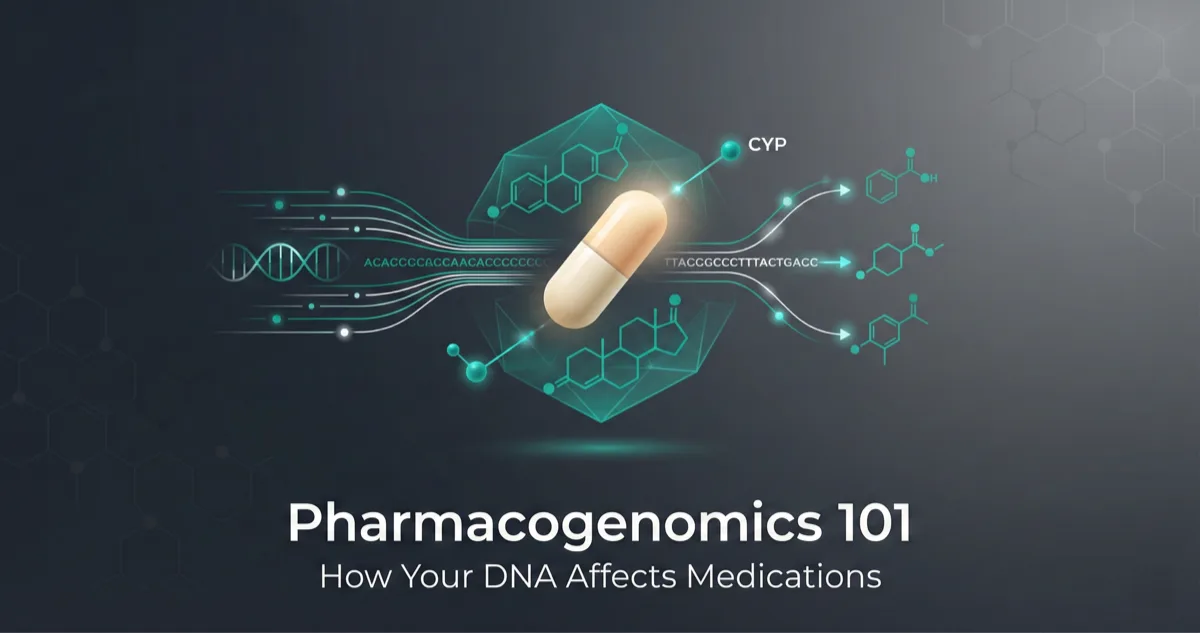
Pharmacogenomics 101: How Your DNA Affects Medications — illustration

Pharmacogenomics 101: How Your DNA Affects Medications

Learn what pharmacogenomics is, how it works, and what the research says — so you can have more informed conversations with your doctor.

By Peter Hollens·Last updated: ·10 min read

Key Takeaways

  • Pharmacogenomics studies how your genes affect drug metabolism — variants in CYP enzymes can cause the same medication to work, fail, or cause dangerous side effects depending on your genotype
  • CYP2D6 and CYP2C19 are the most impactful drug metabolism genes, collectively affecting a large share of common prescriptions including antidepressants, opioids, and blood thinners
  • The FDA includes pharmacogenomic information on hundreds of drug labels, and CPIC publishes peer-reviewed prescribing guidelines based on genotype
  • You can extract pharmacogenomic variants from existing 23andMe or AncestryDNA raw data — DNA Explore analyzes them locally in your browser for $9.99 with no data upload required
“I signed up for 23andMe in 2017 because I was fascinated by what my DNA could tell me. Six years later, my data was compromised in their breach — I'm a confirmed class member in the litigation. I didn't want to hand my genetic data to another company, so I built a tool where everything stays on your device. Then I thought: why not give people what I was actually searching for when I got my DNA tested in the first place — actionable health insights, drug metabolism analysis, risk scores — things you can actually do something with.”

Peter Hollens

Founder, DNA Explore · Wikipedia

What Is Pharmacogenomics?

Pharmacogenomics — sometimes called pharmacogenetics — is the study of how your DNA affects the way your body responds to medications. The term combines "pharmacology" (the science of drugs) and "genomics" (the study of genes and their functions). While most prescriptions are dosed based on population averages, pharmacogenomics recognizes that genetic variation between individuals can cause the same drug at the same dose to work perfectly for one person, fail completely for another, or cause dangerous side effects in a third. Studies suggest the vast majority of people — with some estimates citing figures of 90% or higher, depending on how broadly variant-drug interactions are defined — carry at least one genetic variant that affects how they process common medications. The field has matured rapidly: the FDA now lists a growing number of drug labels that include pharmacogenomic information, and major medical centers like Mayo Clinic, St. Jude Children's Research Hospital, and Vanderbilt University Medical Center have implemented pharmacogenomic testing in clinical care. The Clinical Pharmacogenetics Implementation Consortium (CPIC) publishes peer-reviewed guidelines that translate genetic test results into specific prescribing recommendations. Pharmacogenomics is increasingly integrated into mainstream clinical practice, with major medical centers and professional guidelines actively incorporating genetic data into prescribing decisions. Understanding your pharmacogenomic profile can help your doctor avoid trial-and-error prescribing, reduce adverse drug reactions (a widely cited 1998 JAMA estimate attributed over 100,000 deaths per year in the U.S. to adverse drug reactions in hospital settings, though methodological debates about that figure persist), and find the right medication at the right dose faster.

CYP Enzymes: The Gatekeepers of Drug Metabolism

Most medications are processed by a family of liver enzymes called cytochrome P450 (CYP) enzymes. Three of the most important are CYP2D6, CYP2C19, and CYP3A4. The CYP450 enzyme family as a whole is estimated to metabolize roughly 70–80% of commonly used drugs that undergo Phase I metabolism, with these three playing the largest roles.

CYP2D6

CYP2D6 is one of the most studied pharmacogenes. It is estimated to metabolize approximately 20–25% of all prescription medications, including many antidepressants, opioids, beta-blockers, and antipsychotics. The CYP2D6 gene is highly polymorphic — over 100 allelic variants have been identified — which is why drug response varies so dramatically between individuals.

CYP2C19

CYP2C19 is critical for activating the antiplatelet drug clopidogrel (Plavix) and metabolizing several proton pump inhibitors and antidepressants like escitalopram and sertraline.

CYP3A4

CYP3A4 is the most abundant CYP enzyme in the liver and is estimated to metabolize approximately 30–50% of commonly prescribed drugs — figures vary by study methodology — including many statins, calcium channel blockers, immunosuppressants, and some chemotherapy agents. Variants in these genes can increase or decrease enzyme activity, which directly changes how fast or slow you break down a given drug. This is why two patients on the same statin dose can have completely different outcomes — one gets effective cholesterol reduction while the other experiences severe muscle pain.

Metabolizer Phenotypes: Poor, Intermediate, Normal, and Rapid

Based on your CYP gene variants, you are classified into a metabolizer phenotype that predicts how quickly you process certain drugs.

Normal (Extensive) Metabolizer

A normal (or extensive) metabolizer has two normally functioning gene copies and processes drugs at the expected rate — standard doses typically work as intended.

Poor Metabolizer

A poor metabolizer has little to no functional enzyme activity, usually due to two loss-of-function alleles. Drugs that depend on that enzyme build up to higher-than-expected levels in the blood, increasing the risk of toxicity and side effects even at standard doses.

Intermediate Metabolizer

An intermediate metabolizer has reduced but not absent enzyme activity, often carrying one functional and one nonfunctional allele. These individuals may need modest dose reductions.

Rapid and Ultrarapid Metabolizer

A rapid or ultrarapid metabolizer has increased enzyme activity, sometimes due to gene duplications — some people carry three or more copies of CYP2D6. These individuals break down drugs too quickly, so standard doses may be ineffective. For prodrugs (medications that require metabolic activation), the pattern reverses: ultrarapid metabolizers convert prodrugs into their active form too quickly, which can cause dangerously high levels of the active compound. Codeine is a classic example — ultrarapid CYP2D6 metabolizers convert codeine to morphine so rapidly that even standard doses can cause respiratory depression. The FDA issued a boxed warning about this risk, particularly in children.

Real-World Drug Examples: SSRIs, Codeine, Statins, and More

Pharmacogenomics has the most actionable evidence for several common drug classes.

SSRIs and Antidepressants

CYP2D6 and CYP2C19 variants significantly affect blood levels of fluoxetine (Prozac), paroxetine (Paxil), sertraline (Zoloft), and escitalopram (Lexapro). CPIC guidelines recommend that clinicians consider dose adjustments or alternative medications for poor and ultrarapid metabolizers — these are guidance documents for healthcare providers, not self-treatment instructions. This is particularly important because antidepressants already take weeks to evaluate — some studies suggest pharmacogenomic-guided prescribing may help reduce the trial-and-error period, though the evidence for SSRIs specifically is still developing.

Codeine and Tramadol

CYP2D6 poor metabolizers get almost no pain relief from codeine because they cannot convert it to morphine. Conversely, ultrarapid metabolizers produce morphine too quickly, risking overdose. The FDA has issued a boxed warning contraindicating codeine use in children under 12 and nursing mothers who are ultrarapid metabolizers, and the label warns of elevated risk in ultrarapid metabolizers generally due to rapid conversion to morphine. If you know your CYP2D6 status, discuss it with your prescribing physician or pharmacist before taking any codeine-containing medication.

Warfarin

Variants in CYP2C9 and VKORC1 together are estimated to explain roughly 35–50% of the dose variability for this blood thinner. The FDA-approved label includes a dosing table based on genotype.

Clopidogrel (Plavix)

CYP2C19 poor metabolizers cannot adequately activate clopidogrel, leaving them at increased risk for heart attack and stroke despite taking the medication. The FDA label carries a boxed warning about this.

Statins

SLCO1B1 variants affect how simvastatin is transported into the liver, and certain genotypes dramatically increase the risk of myopathy (muscle damage). CPIC guidelines recommend lower doses or alternative statins for carriers of the SLCO1B1 *5 allele.

FDA Pharmacogenomic Labels and Clinical Guidelines

The FDA maintains a Table of Pharmacogenomic Biomarkers in Drug Labeling that currently includes hundreds of drug-gene associations. These labels range from informational (mentioning that a genetic variant may affect response) to actionable (recommending or requiring genetic testing before prescribing). Some of the strongest FDA pharmacogenomic recommendations include: abacavir (HIV drug) requires HLA-B*5701 testing before prescribing to avoid potentially fatal hypersensitivity reactions; carbamazepine labels recommend HLA-B*1502 testing in patients of Southeast Asian ancestry due to the risk of Stevens-Johnson syndrome; and the clopidogrel label carries a boxed warning about CYP2C19 poor metabolizers. Beyond the FDA, the Clinical Pharmacogenetics Implementation Consortium (CPIC) has published peer-reviewed guidelines covering a growing number of drug-gene pairs — see their website for the current count. The Dutch Pharmacogenetics Working Group (DPWG) provides a complementary set of European guidelines. These aren't theoretical — they provide specific, evidence-based recommendations like "use an alternative drug" or "reduce dose by 50%." Major health systems are increasingly adopting preemptive pharmacogenomic testing, where patients are genotyped before they need a prescription, so the information is already in their medical record when a relevant drug is prescribed. This shift from reactive to preemptive testing is a major trend in precision medicine.

How to Get Your Pharmacogenomic Profile

There are several ways to access pharmacogenomic information. Clinical pharmacogenomic tests ordered through your doctor or providers such as GeneSight (now part of Myriad Genetics), OneOme, or panels from major reference labs provide CLIA-certified results that can be placed directly into your medical record. These are the gold standard for clinical decision-making, and coverage is expanding — some insurers are beginning to cover testing when specific criteria are met, though coverage remains inconsistent and patients should verify with their insurer. However, if you have already taken a consumer DNA test from 23andMe or AncestryDNA, your raw genotype data contains many of the key pharmacogenomic variants. (Note that 23andMe filed for bankruptcy in early 2025 and was subsequently acquired — if you have 23andMe data, consider downloading your raw data while you still have access. You may also want to read about the 23andMe data breach and how to protect your DNA data.) The challenge is extracting and interpreting that information — which is where tools like DNA Explore come in. DNA Explore analyzes your raw DNA file entirely in your browser (your data never leaves your device — learn more about how browser-local DNA analysis protects your privacy) and includes a pharmacogenomics section that reports your estimated metabolizer status for key CYP enzymes and notes variants with published drug-gene associations — as educational context for a conversation with your doctor. At $9.99 one-time, it is a fraction of the cost of clinical pharmacogenomic panels, which can run $250-$2,000 without insurance. It is important to understand that consumer DNA chips do not test every possible variant in these genes — they cover the most common and well-studied ones but may miss rare alleles. This means a consumer-derived pharmacogenomic report is a useful starting point for conversations with your doctor, not a replacement for clinical-grade testing when a specific prescribing decision is on the line.

Limitations and What Pharmacogenomics Cannot Tell You

Pharmacogenomics is powerful, but it has real limitations that are important to understand.
  • Genetics is only one factor in drug response. Your age, weight, kidney and liver function, other medications (drug-drug interactions), diet, and even your gut microbiome all influence how you metabolize drugs. A pharmacogenomic test captures the genetic piece, not the whole picture.
  • Not all drugs have strong pharmacogenomic evidence. While the data for warfarin, clopidogrel, codeine, and many SSRIs is robust, many medications have limited or no pharmacogenomic guidelines yet. The field is growing rapidly, but it does not yet cover every drug you might take.
  • Consumer DNA tests use genotyping chips, not whole genome sequencing. They test specific known variants but can miss rare or novel mutations. For example, CYP2D6 has complex structural variations (gene deletions, duplications, and hybrid genes) that are difficult to detect with standard genotyping arrays. A clinical pharmacogenomic test using targeted sequencing or copy number analysis will be more comprehensive.
  • Pharmacogenomic results describe probabilities, not certainties. Being classified as a "poor metabolizer" means you are likely to process a drug slowly, but individual responses still vary.
Always discuss pharmacogenomic findings with your healthcare provider before starting, stopping, or changing any medication.

The Future of Pharmacogenomics and Precision Medicine

Pharmacogenomics is at an inflection point. As of 2026, several trends are accelerating its adoption. Preemptive testing programs at major medical centers are proving that having pharmacogenomic data in a patient's chart before prescribing improves outcomes and reduces adverse drug events. Research programs such as the IGNITE Pragmatic Trials Network and the eMERGE Network have demonstrated that routine pharmacogenomic implementation is feasible in diverse healthcare settings. Electronic health record (EHR) integration is maturing — clinical decision support systems can now automatically alert prescribers when a patient's genotype suggests a drug-gene interaction, recommending dose adjustments or alternatives in real time. Insurance coverage is expanding, particularly for psychiatric pharmacogenomics, where the evidence for reducing failed medication trials is strong. The cost of testing continues to drop, making it more accessible. For consumers, tools like DNA Explore can extract pharmacogenomic variant information from existing raw data files — processing it locally in the browser with no data uploaded to servers. While these consumer reports are educational and should be discussed with a doctor before acting on them, they represent an important step toward a future where every patient knows their pharmacogenomic profile before their first prescription. The connection between pharmacogenomics and other areas of personal genomics — such as methylation pathways like MTHFR — is also becoming clearer as research advances. Disclaimer: This article is for educational purposes only and does not constitute medical advice. Never start, stop, or change any medication based on genetic information without consulting your healthcare provider.

Frequently Asked Questions

What is pharmacogenomics and why does it matter?
Pharmacogenomics is the study of how your DNA affects your response to medications. It matters because genetic variants in drug-metabolizing enzymes like CYP2D6 and CYP2C19 can cause standard drug doses to be ineffective, cause side effects, or even be dangerous. Some estimates suggest 90% or more of people carry at least one variant that may affect drug metabolism, depending on how broadly variant-drug interactions are defined. Understanding your pharmacogenomic profile helps your doctor choose safer, more effective medications and avoid adverse reactions.
How does CYP2D6 affect medications?
CYP2D6 is a liver enzyme estimated to metabolize approximately 20–25% of prescription drugs, including many antidepressants, opioids like codeine and tramadol, beta-blockers, and antipsychotics. Variants in the CYP2D6 gene can make you a poor metabolizer (drugs build up, increasing side effect risk), an intermediate metabolizer, a normal metabolizer, or an ultrarapid metabolizer (drugs are cleared too fast for standard doses to work). The FDA has issued warnings about CYP2D6 and specific drugs like codeine.
Can I get pharmacogenomic information from my 23andMe or AncestryDNA data?
Yes. Your raw DNA file from 23andMe or AncestryDNA contains many key pharmacogenomic variants. Tools like DNA Explore can analyze your raw data in your browser for $9.99 and report your predicted metabolizer status for major CYP enzymes. However, consumer genotyping chips do not capture every possible variant, so these results are a useful starting point for discussion with your doctor, not a replacement for clinical-grade pharmacogenomic testing.
Should I change my medications based on pharmacogenomic results?
No — never change, stop, or start any medication based solely on genetic information without consulting your healthcare provider. Pharmacogenomic data is one piece of the puzzle. Your doctor considers your full medical history, other medications, lab results, and clinical context alongside genetic data. Use your pharmacogenomic profile as a conversation starter with your doctor, not as a self-prescribing tool.
Which drugs have the strongest pharmacogenomic evidence?
The drugs with the most actionable pharmacogenomic evidence include clopidogrel (CYP2C19 — FDA boxed warning), codeine and tramadol (CYP2D6 — FDA boxed warning regarding ultrarapid metabolizers), warfarin (CYP2C9 and VKORC1 — FDA dosing table), abacavir (HLA-B*5701 — required testing), simvastatin (SLCO1B1 — myopathy risk), and several SSRIs including escitalopram and sertraline (CYP2C19 and CYP2D6). CPIC has published peer-reviewed guidelines for all of these.

Sources & References

  1. FDA Table of Pharmacogenomic Biomarkers in Drug Labeling
  2. Clinical Pharmacogenetics Implementation Consortium (CPIC) Guidelines
  3. DNA Explore Methodology

Disclaimer: The information provided in this article is for general educational and informational purposes only and does not constitute medical, legal, or financial advice. Genetic information should not be used as a substitute for professional medical advice, diagnosis, or treatment. Always consult a qualified healthcare provider before making any health decisions based on genetic data.

Prices, features, and availability of third-party products and services mentioned in this article are based on publicly available information as of the publication date and may have changed. We make reasonable efforts to ensure accuracy but cannot guarantee that all pricing, feature descriptions, or company information is current or complete. Trademarks and brand names referenced are the property of their respective owners and are used solely for identification and comparison purposes.

Genetic risk assessments, polygenic risk scores, and pharmacogenomic reports generated by any consumer tool — including DNA Explore — are based on currently published research and known associations. They are not diagnostic. Genetic predisposition does not guarantee the development or absence of any condition.

See what your DNA says about you

Drop your 23andMe or AncestryDNA file. Results in seconds. $9.99 to unlock everything.

Try DNA Explore free

Already purchased? Restore your access